

How play unlocks curiosity, resilience, and deeper understanding.
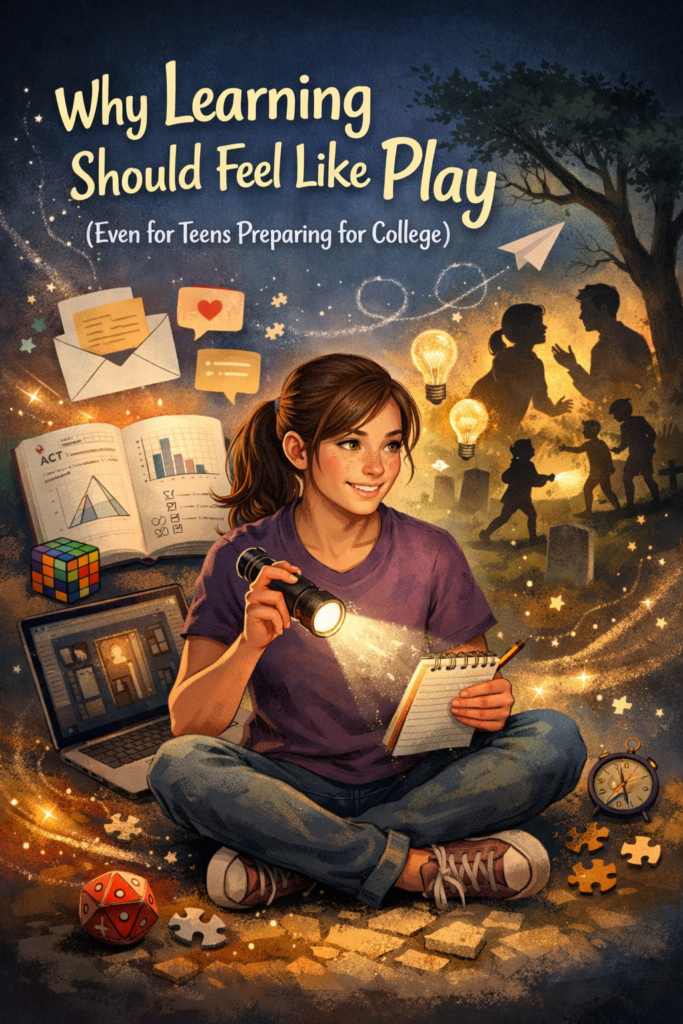
So, I usually start my tutoring sessions by asking how my student’s week has gone. Last week, one of my ACT students sounded a little stressed, and when I asked her to elaborate, I heard her voice crack. As soon as I said, ‘Tell me,’ I got a story about a teen trying to figure things out on her own and bumping up against parents who still wanted to have say in her decisions. It’s not an uncommon issue between teens and parents, but I heard her explain that she’d tried talking to her mom about a specific issue, but she didn’t feel heard, and she didn’t get the space to articulate her thoughts that she was hoping for. As a result, she took it upon herself to make a choice to support her mental health, and the consequences of that decision were both of her parents scolding her, which shut her down. When the tears started, I knew there was no way we could jump into ACT math right then.
It was understandable that she was still feeling the electricity from that encounter when we started our session. But as her tutor, my job is to help her learn how to solve problems – not just memorize problem-solving steps but actually figure out what to do. So after she explained her situation, I pointed out that she did a great job naming the what of the situation. She was very articulate in explaining what happened and why she made the choice she did. Then I asked her how she wanted to handle it. And on her own, she decided that maybe writing them a letter would be helpful. She wouldn’t have to worry about shutting down in a moment of confrontation, and she’d lately taken up writing as a way to process things anyway.
After about 20 minutes, she seemed calm enough to pivot, so I asked her what she wanted to do. She laughed and said she wasn’t sure, so I asked her about her favorite games. It was a delightful line of inquiry – I got a fantastic story about a game she and her neighborhood friends made up to play in the local cemetery – a version of flashlight tag with a story. Here, I pointed out that she was already familiar with naming objectives and constraints – key steps in solving ACT math problems – and we eventually wandered into an online two-player escape room puzzle. It took about another 20 minutes, but after we solved it, my student exclaimed, ‘That was fun!’
All right, parents – I hear you out there saying, ‘But what about the ACT math?’ Let me explain why that session was a tutoring win. My student came in with an issue and figured out on her own how to deal with it. That’s problem-solving. She took the time to name it and look at all its angles and features, and then she took her values and well-being into consideration, and she took well-reasoned, deliberate steps to change a situation that was impacting her mental health. Who could want anything more? By the end of the session, the tears were done, she’d solved a complex, multi-step problem (in the form of an escape room), and she even cracked a joke.
The ACT math section rewards students who can quickly identify problem types and immediately apply the right problem-solving algorithms to them. But not all problems are fast. Some problems require time, reflection, and the courage to sit with uncertainty. During our session, we didn’t technically work on ACT math, but my student did work through a real-life problem that didn’t have a formula, a diagram, or a neat set of answer choices. She recognized the ‘problem type’ – feeling unsupported in a difficult decision – and then spent time sorting through her values, her fears, and her options. It wasn’t a quick name-it-and-solve-it moment, but the flexible thinking she practiced, the confidence she reclaimed, and the experience of solving a messy, human problem will absolutely show up in her math performance. When a student learns that she can figure out something hard in her real life, she’s building the very architecture she’ll use to figure out everything else – including ACT math.
And play? Play is absolutely the key in my tutoring. Play helps calm the nervous system and re-engages the frontal lobe. I don’t expect students to be able to focus on intellectual or executive functioning tasks if they’re stressed or anxious about something. Play also strengths pattern recognition, problem-solving, and flexible thinking. My student didn’t just perform problem-solving steps; she inhabited her solution. She showed that she’s fully capable of making meaningful connections, seeing patterns, and figuring out what to do with clues. And on my end, play helped me better understand her thinking style. I learned that my student picks up on visual patterns very easily, that she doesn’t instinctively prefer spatial reasoning, and that she’s pretty good at reading a situation in the moment and seeing multiple possibilities simultaneously. That will absolutely inform how I tailor her sessions going forward.
The real work of learning is not just mastering content but becoming someone who can meet the world with curiosity, courage, and play. Imagine generations of humans who have learned through playfulness how to attune to others, how to resolve conflicts, how to cooperate and solve problems. Or, just imagine a teenage girl becoming herself.